
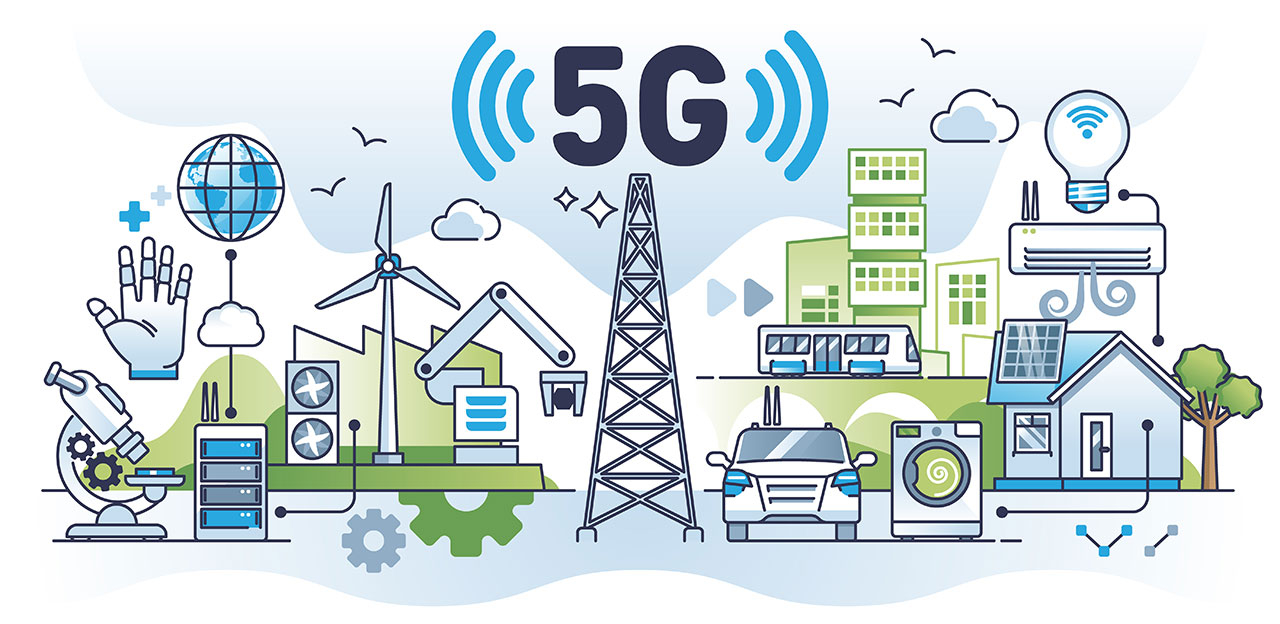
The fifth generation of wireless technology is about more than just speed; it is about creating a versatile and programmable network fabric. This is the promise of 5G Network Slicing, a revolutionary network architecture concept that allows mobile operators to partition a single physical 5G network into multiple, isolated virtual networks. Each of these "slices" can be independently customized with its own specific characteristics for speed, latency, security, and capacity. This groundbreaking capability enables operators to move beyond a one-size-fits-all approach and deliver tailored, guaranteed Quality of Service (QoS) for a diverse range of applications and enterprise customers. It is the core technology that transforms the 5G network from a monolithic utility into a dynamic platform for innovation and new service creation.
This versatility is best understood through the three primary types of network slices defined by 5G standards. The first is enhanced Mobile Broadband (eMBB), designed to provide massive bandwidth and high data rates, ideal for applications like 4K video streaming, augmented reality, and fixed wireless access. The second is Ultra-Reliable Low-Latency Communications (URLLC), which offers extremely low latency and high reliability, making it essential for mission-critical use cases such as autonomous vehicles, remote surgery, and industrial automation. The third is massive Machine-Type Communications (mMTC), which is optimized to support a vast number of low-power, low-data-rate devices, perfect for massive IoT deployments like smart city sensors and agricultural monitoring. An operator can deploy all three slice types simultaneously on the same infrastructure.
The magic behind network slicing is enabled by a suite of modern technologies, primarily Software-Defined Networking (SDN) and Network Functions Virtualization (NFV). NFV allows network functions like firewalls and routers to run as software on standard servers, while SDN decouples the network's control plane from the data plane, making the network centrally programmable. Combined with an end-to-end orchestration platform, these technologies give operators the power to dynamically create, manage, scale, and decommission network slices on demand. This software-driven approach provides the agility and automation necessary to manage the complexity of thousands of unique network slices, unlocking the full commercial and technical potential of 5G.
